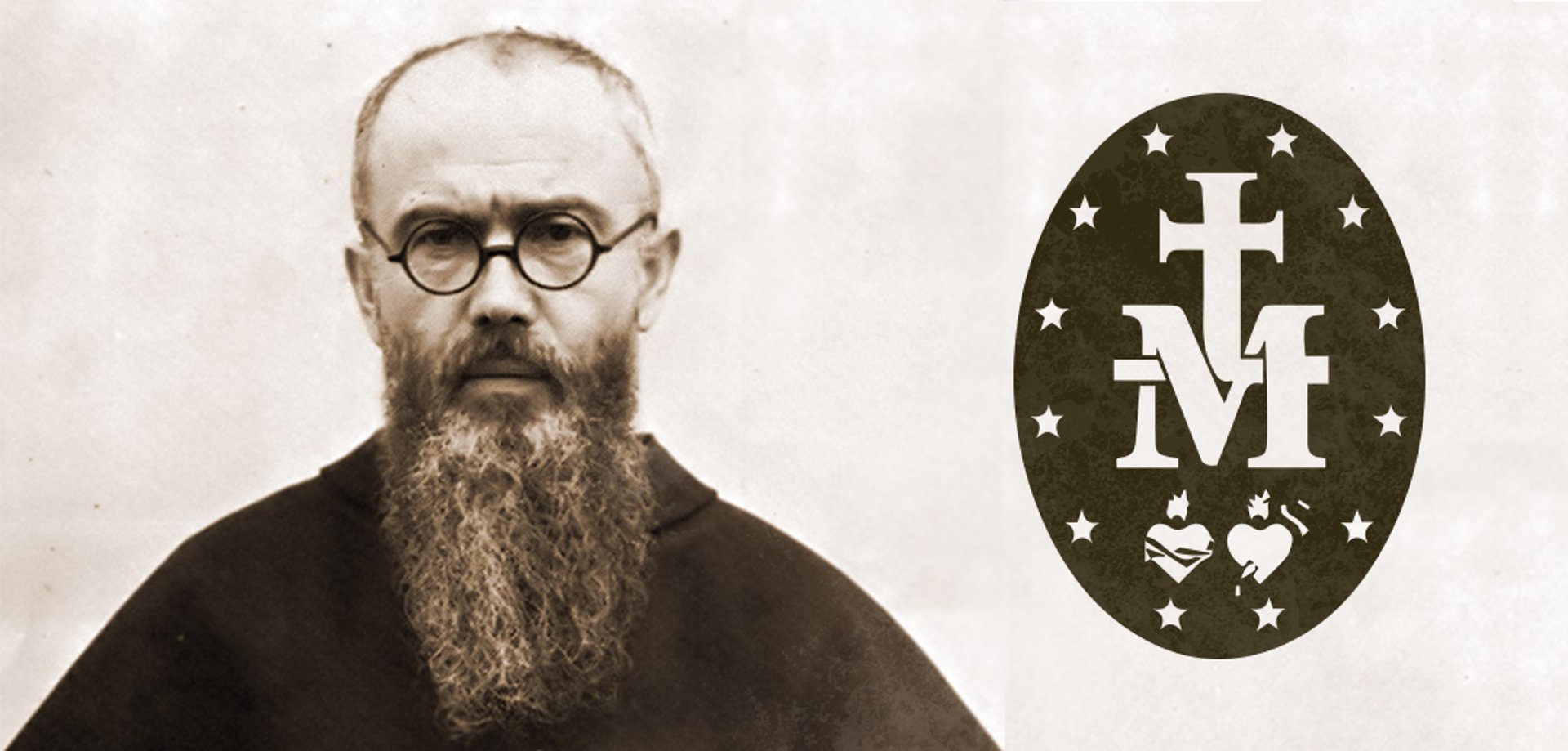
St. Maximilian Kolbe was a member of the Order of Friars Minor Conventual. The second of five sons, he was born in January of 1894 in Zduńska Wola, a small town in Poland. When he was just ten years old, Maximilian experienced a vision of Mary, the Mother of God. She held two crowns — a white crown, which represented purity, and a red crown, which represented martyrdom. Kolbe accepted both, a decision that would change his life. He decided to follow the path to become a Franciscan friar and was ordained to the priesthood on 28 April, 1918.
While studying in Rome, Maximilian Kolbe founded the Knights of Mary Immaculate, also known as the Militia Immaculata or MI, an organisation dedicated to promoting devotion to Mary. In 1922, he opened a publishing house and promoted the work of the MI through his magazine, The Knight of the Immaculata. His publications were translated into many languages and sent around the world. He decided to move the publishing house to the country, where he built the Niepokalanów monastery, also known as the “City of the Immaculata”. By 1937, Niepokalanów was the largest friary in the world.
Until this day, the Militia Immaculata continues to promote devotion to Mary, and its members can be found all around the world.
In 1930, Maximilian’s superiors sent him to Japan to set up a second publishing house on the outskirts of Nagasaki. Just as they had done in Niepokalanów, the friars built their friary and publishing house from whatever materials they could find. Displayed in our College Chapel are some boards from a packing case taken from Fr Maximilian’s office, which he built himself from materials gathered at the wharf in Nagasaki. Kolbe shared a deep love for Japan — its culture, language and people — and lived and worked in Japan for six years.
Martyr of Charity
When World War II broke out in 1939, Poland was invaded by Germany. The Nazis saw Fr Maximilian as a threat, and they eventually sent him to Auschwitz in May, 1941. When he arrived at the death camp, he was given the number 16670 and became a faceless, nameless prisoner, just like the others held in the camp. Kolbe’s time at Auschwitz was short, not even three months.
At the end of July, a prisoner escaped from the block where Fr Maximilian was kept. The Commandant ordered the occupants to stand in line outside the block. He chose ten men to die, as a warning to others not to attempt escape. When Franciszek Gajowniczek, a Polish soldier, pleaded for his life, Fr Maximilian stepped forward and offered to die in his place. The ten men, including Kolbe, were taken to an underground cell to be starved to death.
On 14 August, the Commandant sent the camp doctor to the men’s cell. The doctor found Fr Maximilian still alive and conscious, sitting propped against the back wall of the cell. Kolbe smiled at the doctor and held out an emaciated arm. The doctor injected him with carbolic acid from a syringe, and Fr Maximilian finally gained the red crown of martyrdom.
Pope St John Paul II, canonised Fr Maximilian Kolbe on 10 October, 1982.